The Predictable Operations Framework
Plan what is achievable. Adjust when reality changes. Process accurately what actually happens.
What is the Predictable Operations Framework?
Only when an organization can answer these three questions throughout the entire operational flow does true predictability emerge.

The seven building blocks of Predictable Operations
Predictable Operations connects capacity, planning, execution, and processing into one operational cycle. Each building block prevents deviations along the way from growing into extra work, higher costs, or margin loss.

1. Capacity planning: see shortages before they become problems
Bring together future tasks, deadlines, and required profiles with the available internal and external capacity.
This way, shortages become visible before they lead to overtime, delays, expensive last-minute solutions, or agreements that are operationally unfeasible.

2. Skills-based planning: plan who is truly deployable
Available is not the same as deployable. Skills, certificates, work schedules, absences, locations, and operational rules determine who can and is allowed to perform a task.
By taking these conditions into account in advance, you avoid incorrect assignments, unnecessary relocations, and rescheduling on the work floor.

3. Workforce planning: build a feasible plan
Combine employees, teams, tasks, projects, equipment, and locations within one realistic plan.
SOLUTIO supports both manual and automatic workforce planning. The planner retains control, while the software makes conflicts and unfeasible combinations visible more quickly.
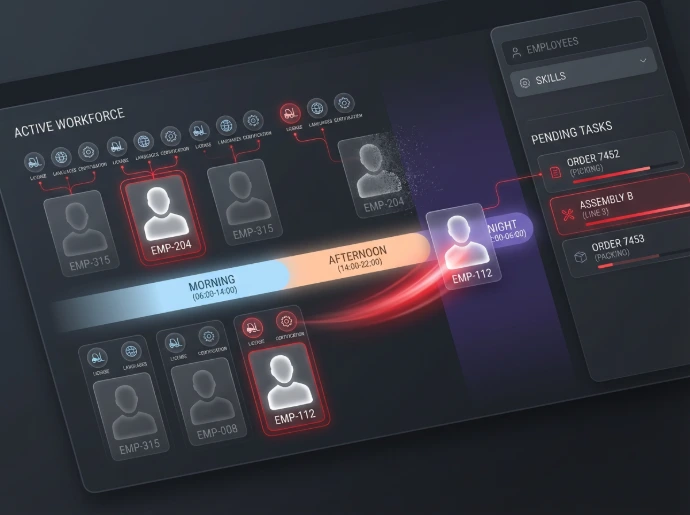
4. Dynamic rescheduling: adjust without chaos
Sickness, delays, or an urgent task quickly makes a plan outdated. Then, not only must a replacement be found, but the impact on other tasks, clients, and work schedules must also be assessed.
SOLUTIO helps find feasible alternatives faster, allowing planners to adjust purposefully without having to rebuild the entire plan.

5. Mobile registration: capture reality
The plan shows what was anticipated. Mobile registration captures what was actually executed.
Hours, mobility, relocations, work orders, and deviations are recorded directly and made available for review and approval. This reduces double entry, missing data, and reconstruction work afterwards.

6. Pre-payroll: make performances payroll-ready
A registered hour is not yet a correct wage code. Hours, overtime, mobility, allowances, and reimbursements must first be interpreted according to collective labor agreements and internal company rules.
VIRO checks the registrations and converts them into correct payroll-ready output. This way, payroll receives fewer errors, exceptions, and manual correction files.

7. Post-calculation: learn from planning versus reality
Compare planned hours and costs with what was actually performed and processed.
By feeding back performances to ERP, reporting, and post-calculation, it becomes visible where capacity, time, and margin are lost. These insights make future estimates and planning more reliable.
One operational flow, no collection of separate systems
Many organizations already have an ERP, HR system, planning solution, time registration, payroll package, and reporting tool today. Yet planners, project leaders, HR, and payroll continue to manually transfer and check data. The problem is usually not that there is too little software.
The problem lies between the systems.
Where a task needs to flow into planning. Where planning is confronted with reality. Where registrations need to be approved. Where hours and allowances go to payroll. Where actual costs are needed again for post-calculation.
Every interruption creates extra work, delays, and chances for errors. The Predictable Operations Framework therefore connects the entire chain:
Demand and capacity → Planning → Execution → Registration → Approval → Pre-payroll → Payroll → Post-calculation
The technology behind Predictable Operations
SOLUTIO
SOLUTIO supports the operational side of the flow.
The solution helps organizations realistically plan people, teams, assignments, projects, locations, and resources. It takes into account skills, certifications, availabilities, work schedules, locations, and operational rules.
When reality changes, SOLUTIO supports quick replanning and dispatching. Mobile registration makes visible what was actually executed.
SOLUTIO not only plans who is available. It helps determine who is actually deployable.
Discover SOLUTIOVIRO
VIRO starts where time registration stops.
Discover VIROWhat Predictable Operations concretely delivers
For planners
Less manual puzzle work, faster rescheduling, and more certainty that employees are actually deployable.
For operations
More control over capacity, assignments, movements, deadlines, and changes during the workday.
For project leaders
Faster insight into planned and actual performance and fewer missing or unclear records.
For HR and payroll
Less Excel dependency, fewer corrections, and a more reliable processing of hours, mobility, allowances, and exceptions.
For management
More insight into productivity, costs, capacity, and project margin.
For employees
Clearer communication and more confidence that performance and compensation are processed correctly.
Make deviations visible before they start costing money
Operational losses rarely result from one major mistake. They build up through flawed planning, delays, missing registrations and payroll corrections that come too late.
Predictable Operations makes these deviations visible earlier. Capacity shortages, planning conflicts and registration errors are addressed before they lead to additional costs, stress and margin loss.
This allows your organisation to respond faster, make better decisions and limit losses when reality deviates from the plan.
Read our blog
Practical insights on planning, time registration, and payroll processing

Discover where your operation loses predictability.
Map the bottlenecks between planning, execution, and processing together with GO-VIRTUAL.