ERP vs planning tools: why operational planning requires more than basic data
An ERP manages your data. But does it also plan your reality?
That is the difference between an ERP and a specialized planning tool.
What does an ERP do well?
- managing projects and orders
- centralizing customers and suppliers
- keeping employee and basic data
- tracking materials, items, and resources
- recording costs and revenues
- supporting invoicing and financial flows
- making master data available for other systems
That is necessary. Without correct basic data, every plan is weak.
But an ERP is usually not built to quickly and realistically process every operational change on the shop floor.
Where does ERP planning often get stuck?
- planners work alongside the ERP in Excel
- changes are communicated manually
- availabilities and absences are not well accounted for in the planning
- skills and certificates are checked separately
- material planning operates separately from personnel planning
- mobile employees receive late or unclear information
- registrations come in only afterwards
- post-calculation lags behind reality
- one or two people know "how it really is"
On paper, the planning seems to be under control. In practice, corrections, discussions, and time loss arise.
Why Availability Is Not the Same as Deployability
An employee may be free in the schedule, but that does not mean they are suitable for the task.
- Maybe a certificate is missing.
- Maybe the employee is already assigned to another team.
- Maybe the right material is not available.
- Maybe the task does not fit within the rules, planning, or mobility.
- Maybe the site context changes on the same day.
An ERP can show who exists, which project is active, and which order is scheduled. But the question of whether the planning is truly feasible requires more logic.


Where SOLUTIO Makes the Difference
SOLUTIO uses ERP data as a starting point and translates it into feasible operational planning.
Think of:
- project and order data from ERP
- employees and resources
- availabilities and absences
- skills and certificates
- tasks, teams, and assignments
- equipment and transport
- operational rules and constraints
- mobile feedback from the shop floor
This creates no separate Excel layer next to the ERP, but a controlled flow between ERP, planning, execution, and post-calculation.
From ERP Master Data to Operational Reality
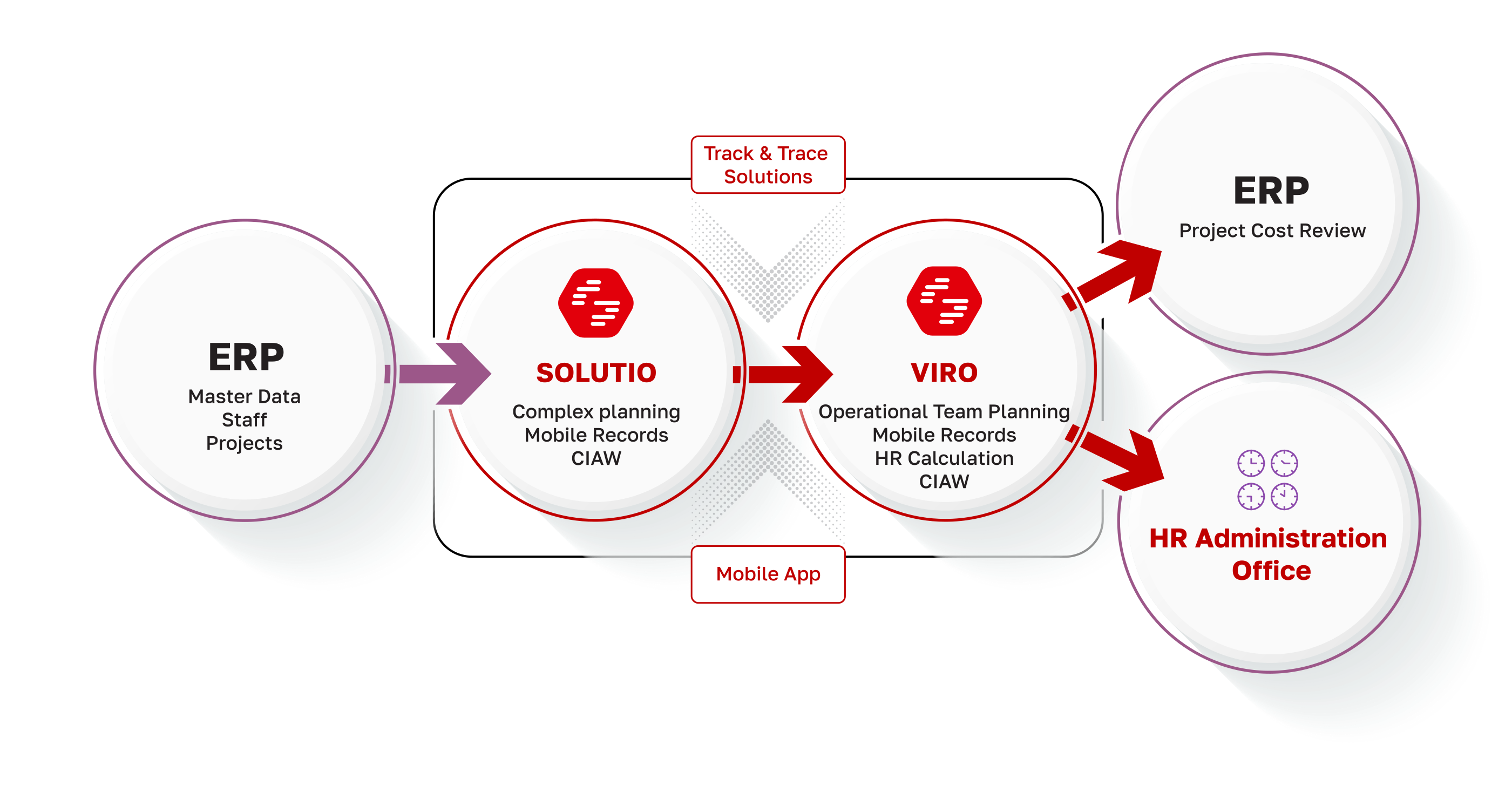
ERP remains important. But it doesn't have to do everything itself. SOLUTIO fills in the operational layer where planning needs to remain fast, realistic, and controllable.
What does it actually change?
When ERP and planning work better together, the loss in the flow decreases.
- less Excel next to the ERP
- fewer manual corrections
- faster rescheduling
- better utilization of people and equipment
- clearer communication to employees
- more reliable registrations from the shop floor
- better approval with context
- stronger post-calculation
- less dependence on individual planners
- more control over time, costs, and margin
The profit lies in less rework afterwards.

When Is ERP Planning No Longer Enough?
A specialized planning solution becomes relevant as soon as you are faced with:
- mobile employees
- multiple sites or locations
- teams or shifts
- resource planning
- skills and certificates
- last-minute changes
- complex availabilities
- operational rules
- mobile work orders
- time registration and mobility
- post-calculation on projects
- recurring Excel work between planning and ERP
If planning today is mainly maintained by human knowledge, loose files, and manual checks, then the problem usually does not lie in the ERP. There is a lack of an operational planning layer.
Should You Replace Your ERP? Usually Not.
The intention is not to replace your ERP.
The better question is:
Where Does ERP End and Operational Planning Begin?
SOLUTIO works as a layer between ERP and the shop floor. It retrieves master data, supports realistic planning, and brings validated execution back to the right systems.
This way, the ERP remains the administrative backbone, while SOLUTIO brings planning closer to reality.
Frequently asked questions answered
In this section, you can efficiently address common questions.
Yes, but usually mainly at an administrative level. For simple planning, that may suffice. Once planning needs to take into account skills, certificates, availabilities, teams, resources, mobility, and last-minute changes, a specialized planning tool is often stronger.
No. SOLUTIO does not replace the ERP. SOLUTIO uses ERP data as a starting point and translates it into feasible operational planning, mobile registration, and feedback to ERP or other systems.
Because the ERP is often not flexible enough for the daily planning reality. Planners use Excel to keep track of exceptions, changes, availabilities, skills, or practical agreements. That works temporarily, but causes errors and dependency.
ERP data describes projects, customers, employees, and resources. Planning data shows how those resources are concretely utilized over time, taking into account availability, rules, execution, and changes.
When planning becomes dependent on multiple conditions: employees, teams, equipment, skills, certificates, absences, mobile registration, approvals, and post-calculation. Then a specialized planning tool is not an extra luxury, but a control layer for the operation.
Have Your Planning Flow Analyzed
Is your planning still running partly outside your ERP today?
Are changes, registrations, or corrections scattered across Excel files, emails, and phone calls?
Then it is time to take a closer look at the flow between ERP, planning, execution, and post-calculation.