
Payroll still closes once a month. But the work that determines whether that close goes smoothly happens every day. Talk to HR teams, payroll specialists and payroll service providers today, and you hear the same shift every time: payroll quality is no longer determined at the pay calculation, but before it. In the registration, the interpretation and the review of exceptions.
This is not a theoretical evolution. It is
visible every month: in the questions that come in, in correction rounds, in
closing stress, and in discussions that are held too late. At GO-VIRTUAL
we see five trends that will fundamentally change the work of the payroll employee in the coming years.
Not because new software is added, but because the
place shifts where payroll goes right or wrong.
“Payroll problems do not arise at the closing. They only become visible there.”


The reality: more data, not less work
HR and payroll have been strongly digitized in recent years. Yet the work for many payroll teams does not feel lighter. On the contrary. Registrations today come from apps, time clocks, schedules, ERP systems, emails, Excel files, and exceptions from operations. They involve four major streams:
- Hours: start, stop, break, night, project
- Mobility: kilometers, zones, allowances, job site context
- Absence: leave, sickness, certificates, balance
- Exceptions: shifts, premiums, collective labor agreements and company rules
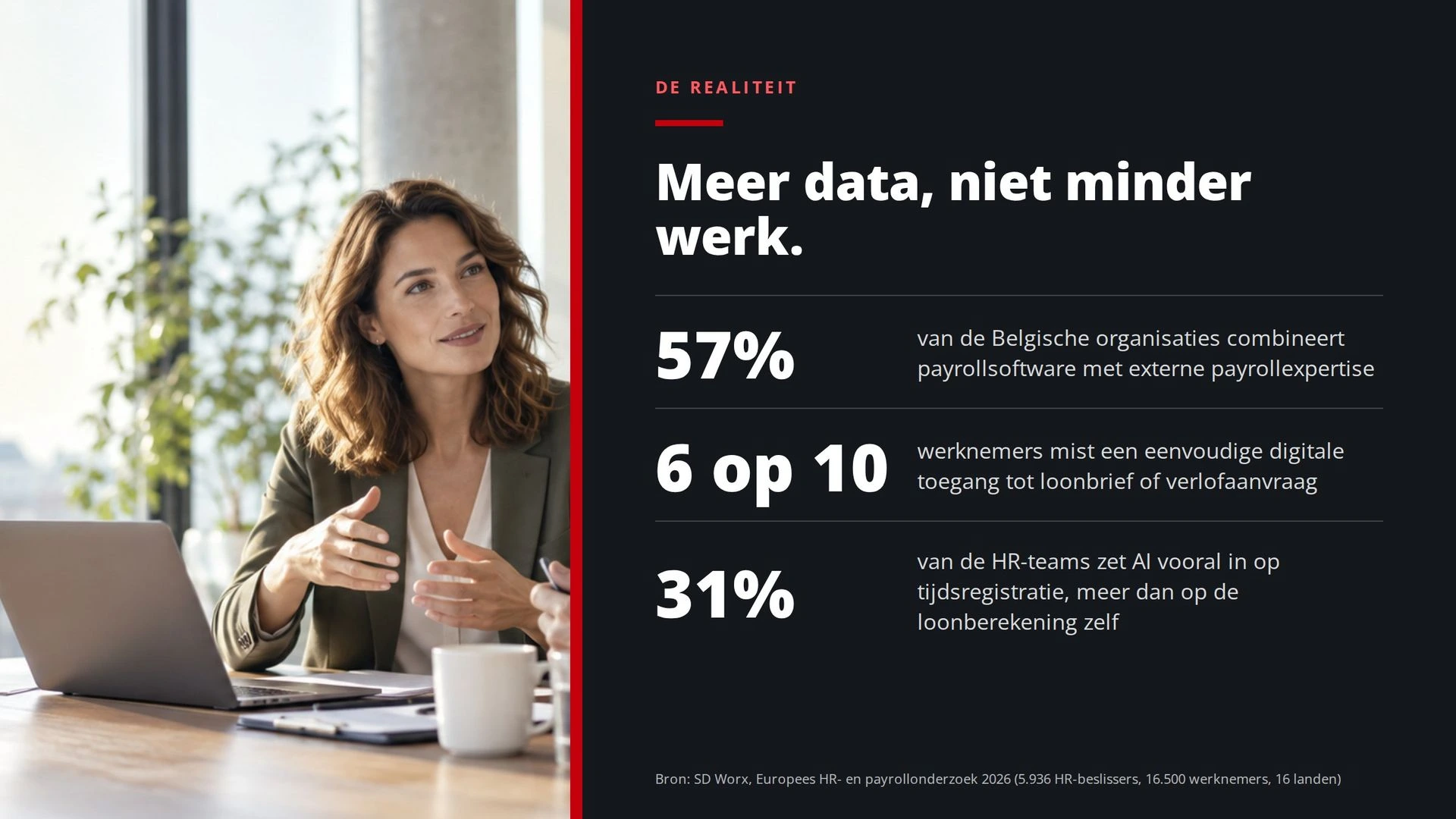
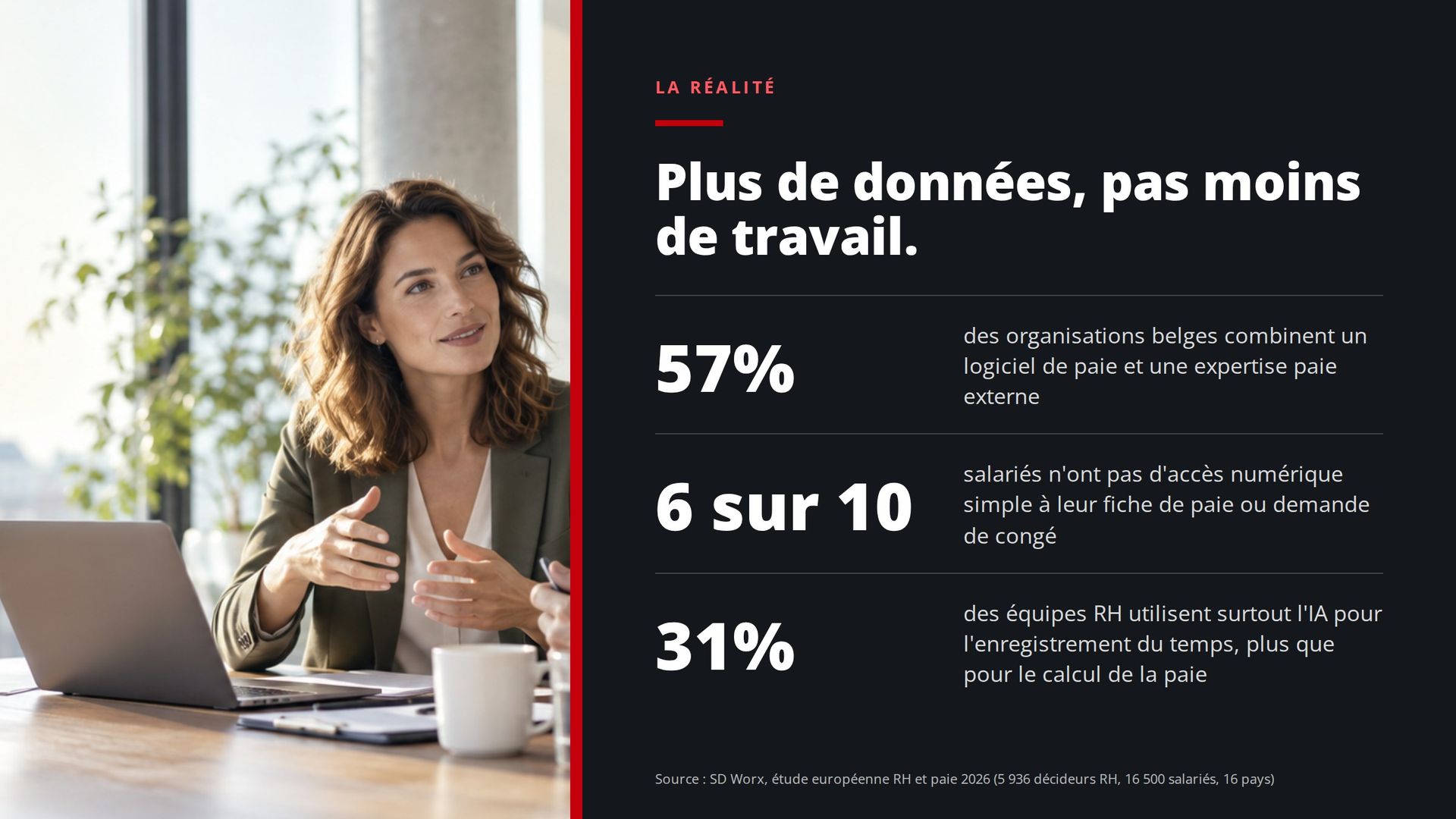
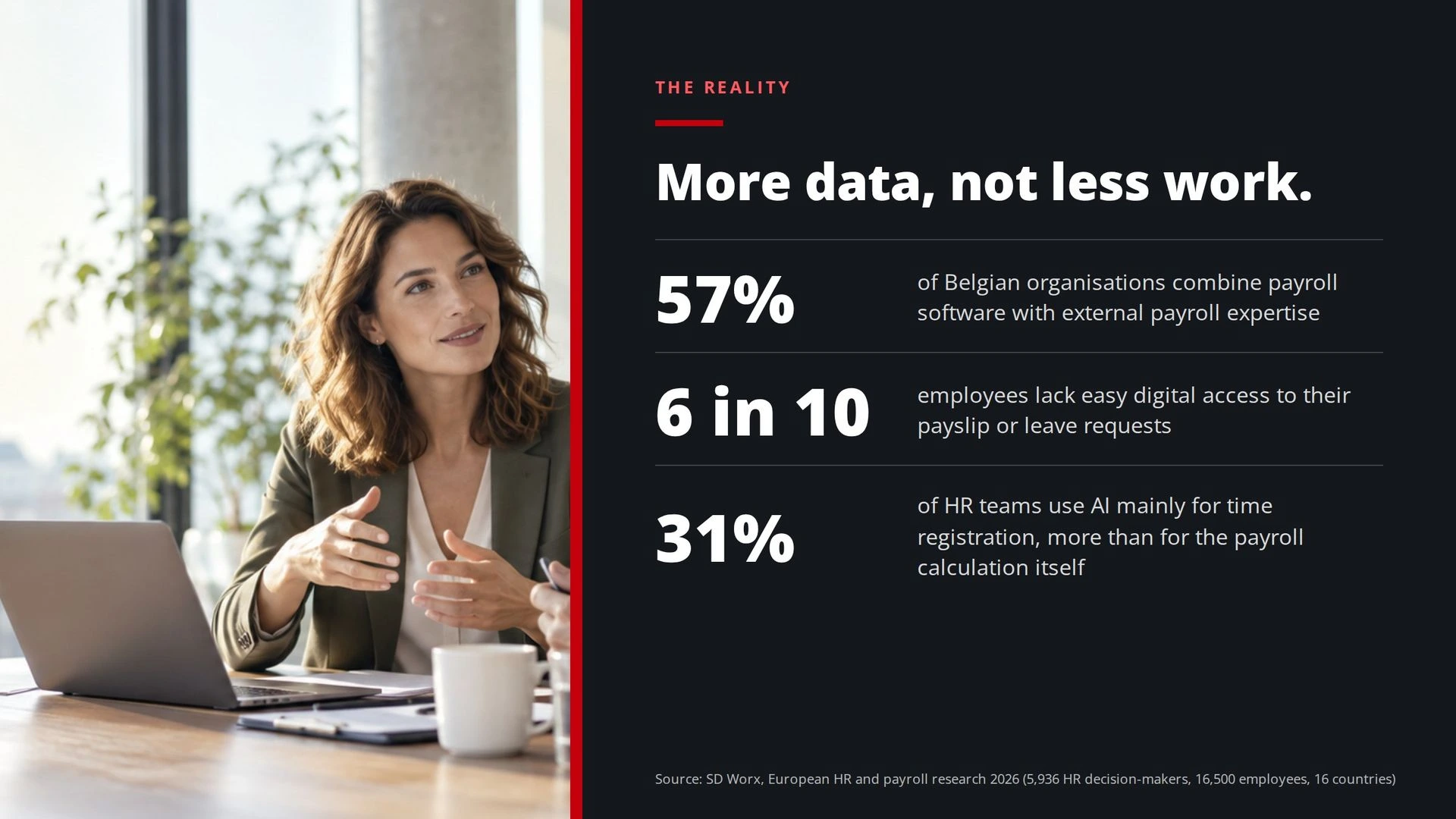
The recent European HR and payroll research by SD Worx (5,936 HR decision-makers and 16,500 employees in 16 countries) confirms that picture. 57% of Belgian organizations combine payroll software with external payroll expertise. Six out of ten employees lack simple digital access to pay slips or leave requests. And where HR uses AI, it mainly happens in time tracking (31%), more than in payroll calculation itself.
The lesson is simple, but uncomfortable: digitizing without control often just means collecting more raw input faster.
The five trends at a glance
Trend | What is changing? | What does it mean for the payroll employee? |
1. Continuous payroll | Not waiting until the closing, but validating earlier. | Less reconstruction work at the end of the month. |
2. Employee self-service | More input comes directly from employees. | More need for automatic control and interpretation. |
3. AI and automation | Faster processing becomes possible. | Only reliable with correct rules and data. |
4. Exception management | Payroll focuses on deviations, not on everything. | The role shifts from checking to assessing. |
5. Audit and compliance | Being correct is no longer enough. | You must be able to demonstrate why something is correct. |
The common thread across all five: payroll quality is shifting to before payroll.
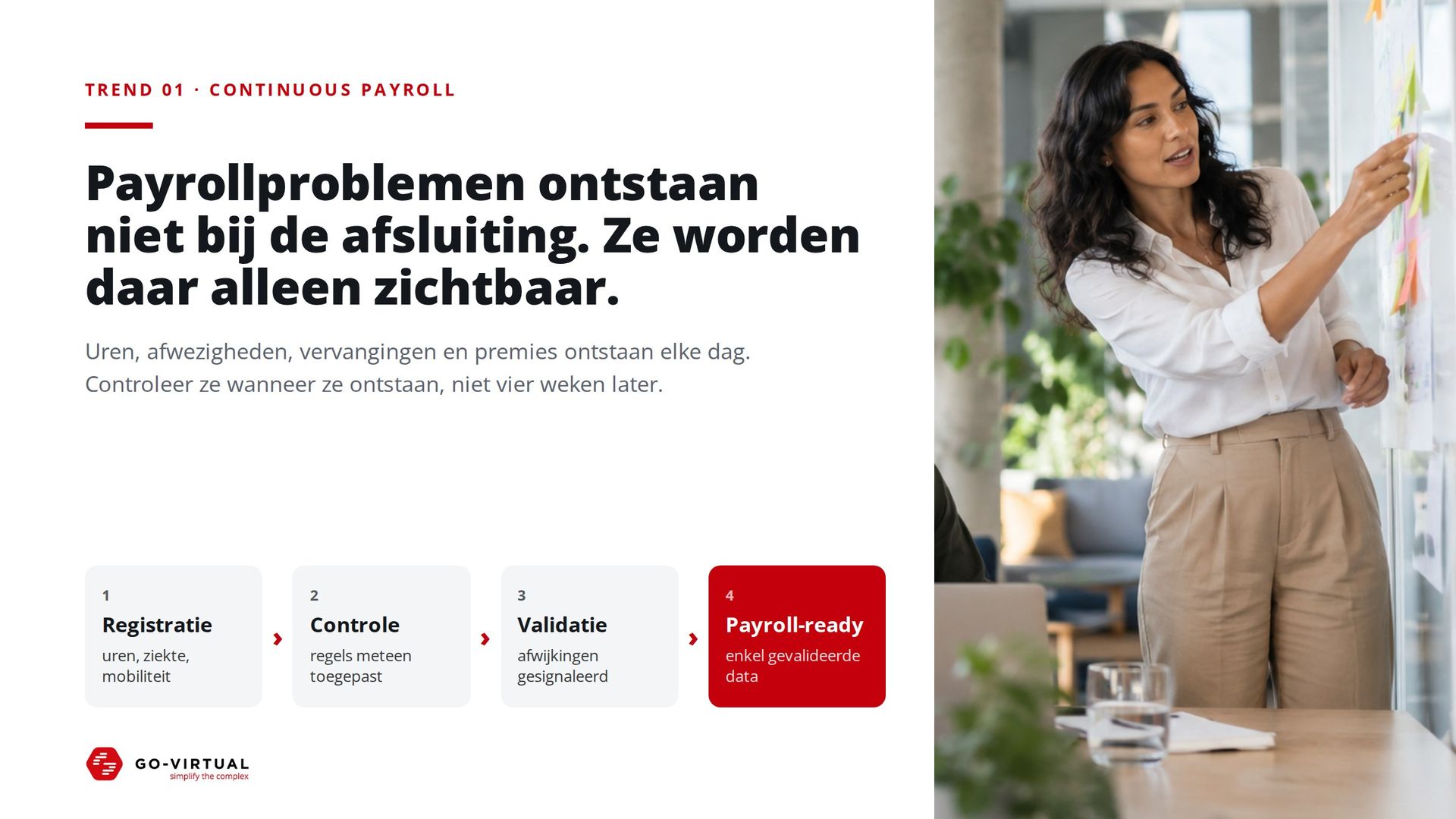
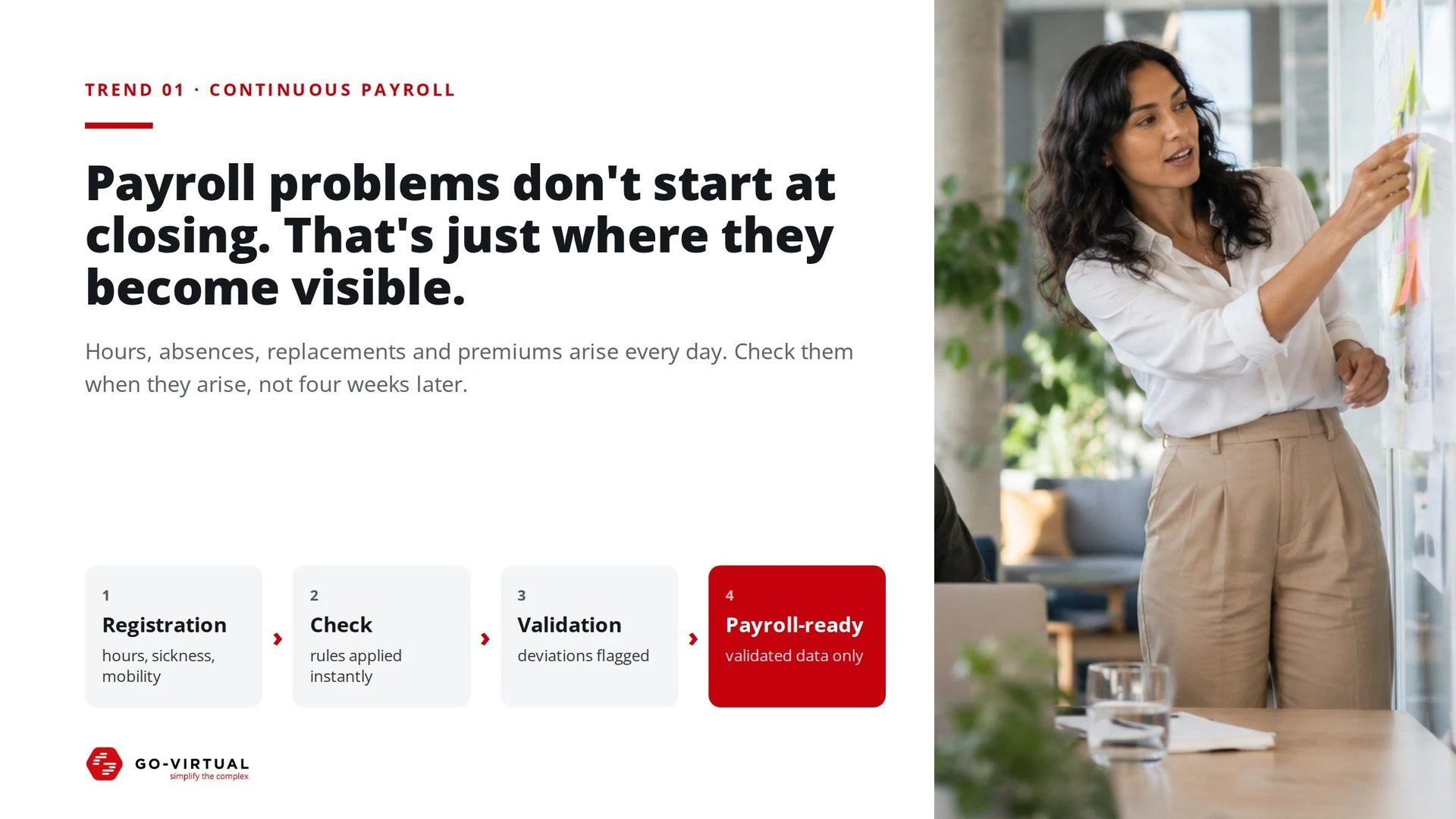
Trend 1: Continuous payroll, validating when data is created
- 06:40. An employee calls in sick. The shift supervisor immediately arranges a replacement.
- 08:30. HR receives the medical certificate. Production keeps running. Everyone acted correctly from an operational point of view.
- Four weeks later. Payroll discovers that the replacement worked different hours, that a premium applies and that a mobility registration needs to be checked.
The problem? The information was there, but it was scattered across planning, registration, HR and operational communication. The result: payroll has to reconstruct what happened weeks ago.

Trend 2: Employee self-service is not an endpoint, but the start of better input
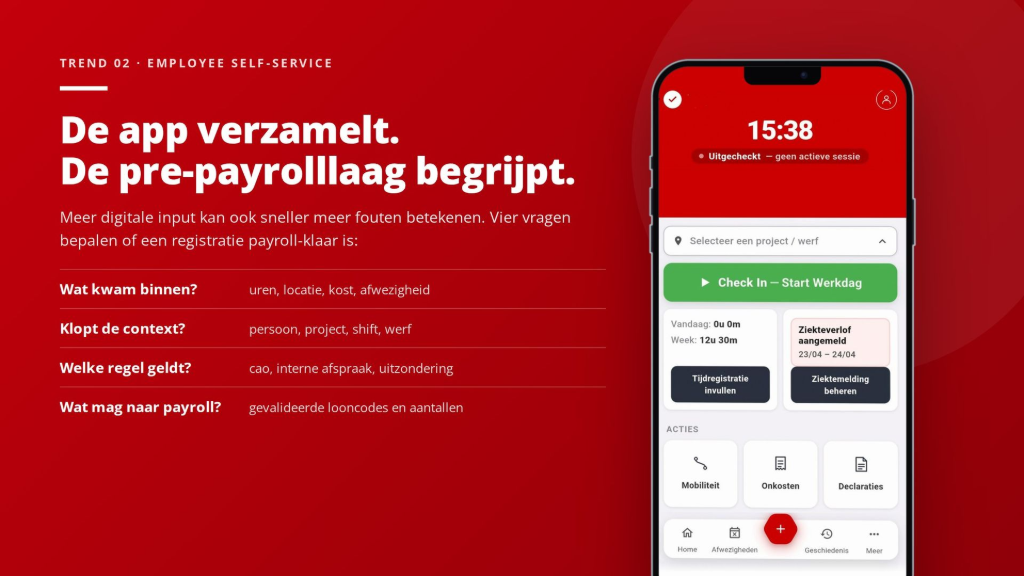
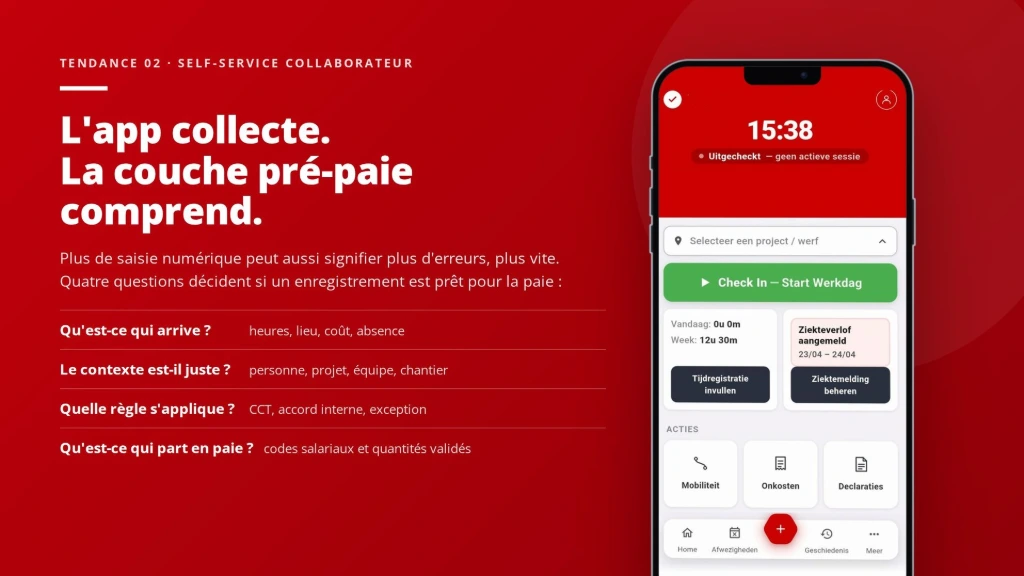
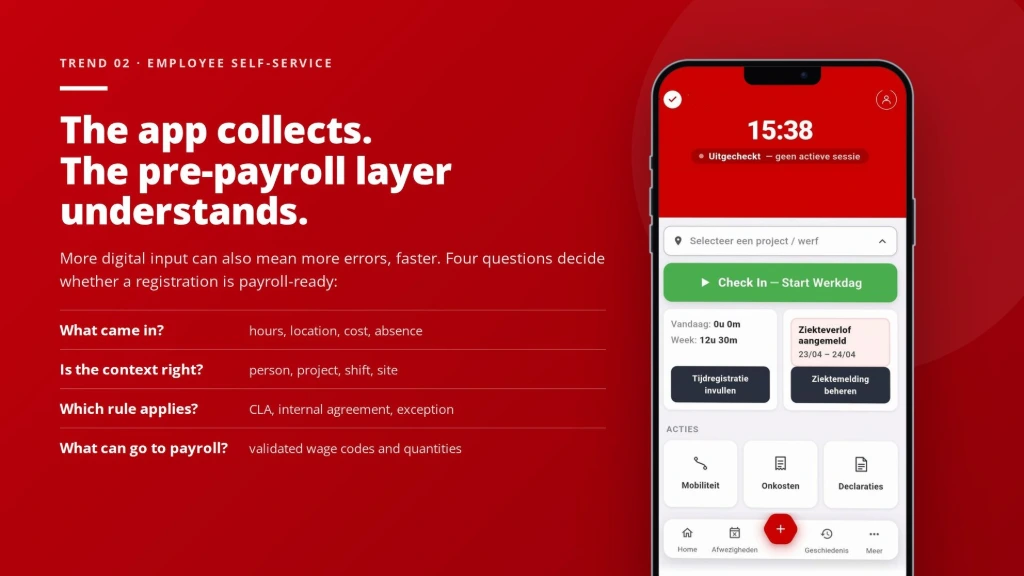
Between a registration in an app and a correct pay code, there are always four questions:
Question | What is it about? |
What came in? | Hours, location, cost, absence |
Is the context correct? | Person, project, shift, site |
Which rule applies? | Collective labor agreement, internal agreement, exception |
What can go to payroll? | Validated wage codes and numbers |
“The app collects. The pre-payroll layer understands.”
Trend 3: AI makes payroll faster, rules make payroll correct
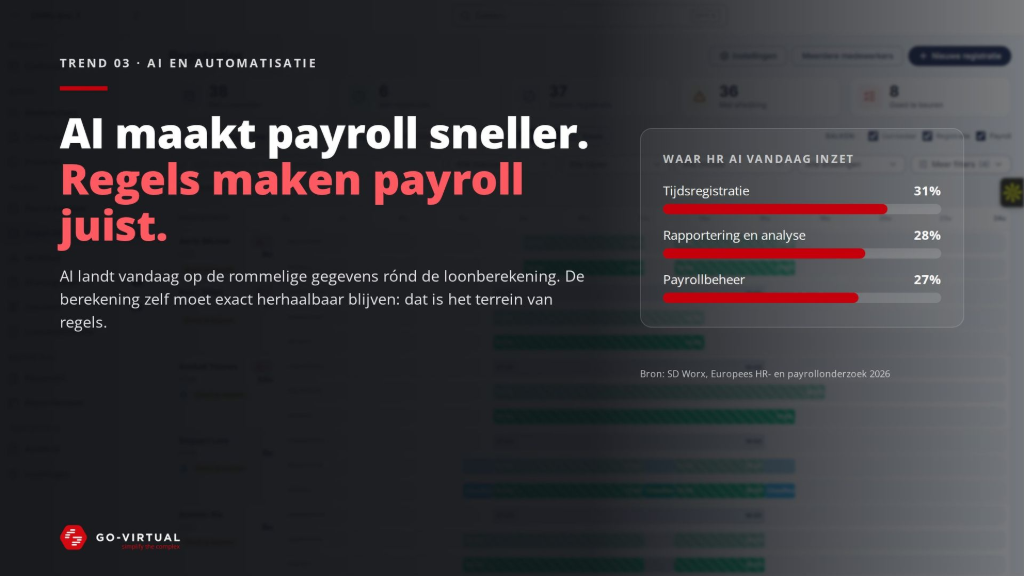
AI is everywhere in the conversation about HR and payroll. But look at where AI actually lands today and you notice something striking. In the European survey, AI is most often applied to time registration (31%), followed by reporting and analytics (28%) and payroll management (27%). So mainly to the messy data around the calculation, not to the calculation itself.
That makes sense. A payroll calculation must be exactly repeatable: the same input must always yield the same output. That is the domain of rules, not probabilities.
Trend 3: AI en regels
A reliable flow looks like this:
- Raw data: registrations, planning, mobility
- Rules: collective labor agreement, contract, entity, project
- Human validation: review of exceptions
- Payroll-ready output: pay codes, quantities, audit trail
Without correct rules, AI also automates incorrect payroll input. So AI does not replace the rule engine. AI only becomes truly useful on top of reliable, interpreted data.
“AI accelerates what already exists. If the rules are incorrect, AI also accelerates the errors.”
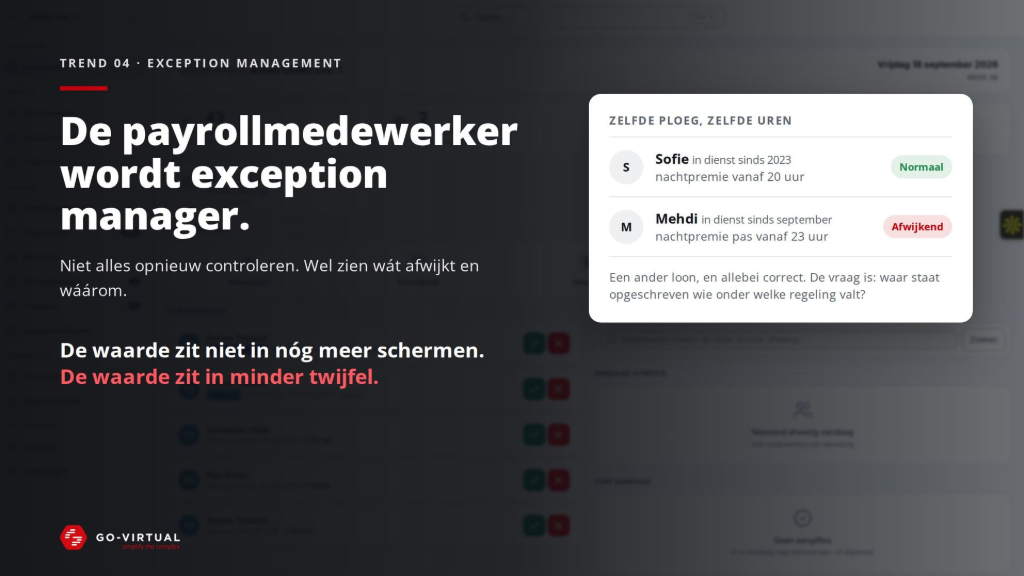
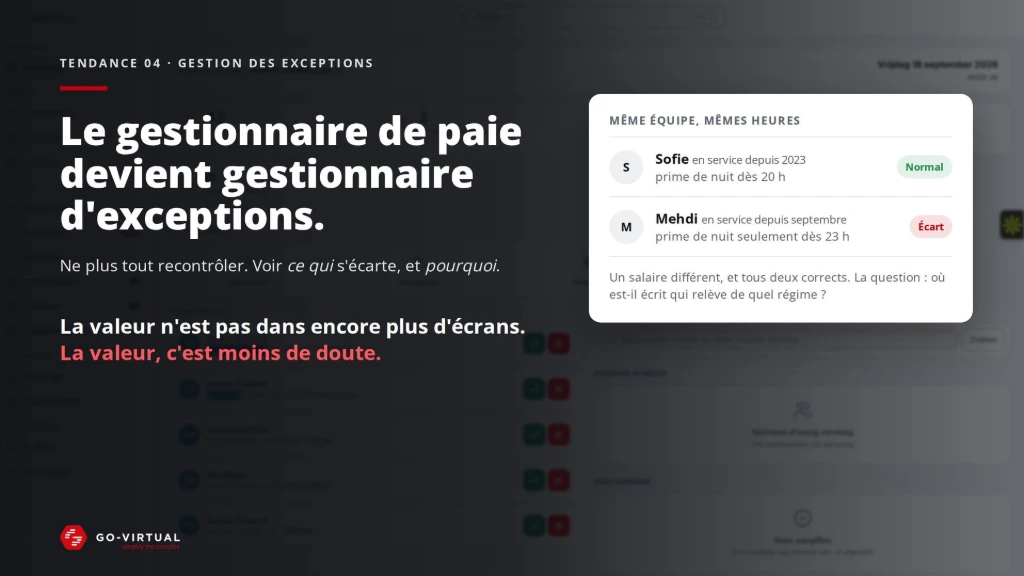
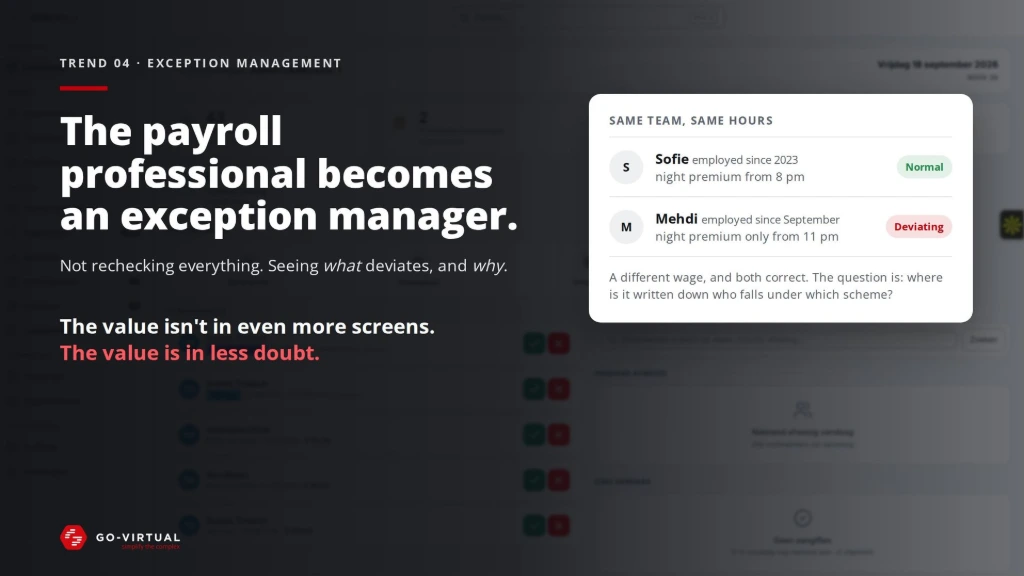
Trend 4: The payroll employee becomes exception manager
The role of the payroll employee is shifting. No longer checking everything again, but seeing what deviates and why it deviates. SD Worx also describes the evolution towards hybrid payroll teams, where technology processes the volume and people validate.
Take two colleagues from the same team:
- Sofie has been employed since 2023 and keeps her night premium from 8 p.m.
- Mehdi has been employed since September and only receives the premium from 11 p.m.
The same hours, the same team, a different wage. And both correct. The question is: where is it written who falls under which scheme? Is that in a system, or in the mind of one experienced colleague?
Status | What happens? |
Normal | Flows automatically. |
Incomplete | Is fed back to the employee or team leader. |
Deviant | Appears on the control list of payroll. |
Validated | Goes correctly to payroll. |
This way, the payroll employee spends his time on the ten percent that deserves attention, not on the ninety percent that is just correct. The value is not in even more screens. The value is in less doubt.
Trend 5: Compliance shifts from knowing to being able to demonstrate
Payroll must not only be correct. It must also be explainable and reproducible. The emphasis on transparency, audibility, and data governance in HR and payroll is visibly increasing.
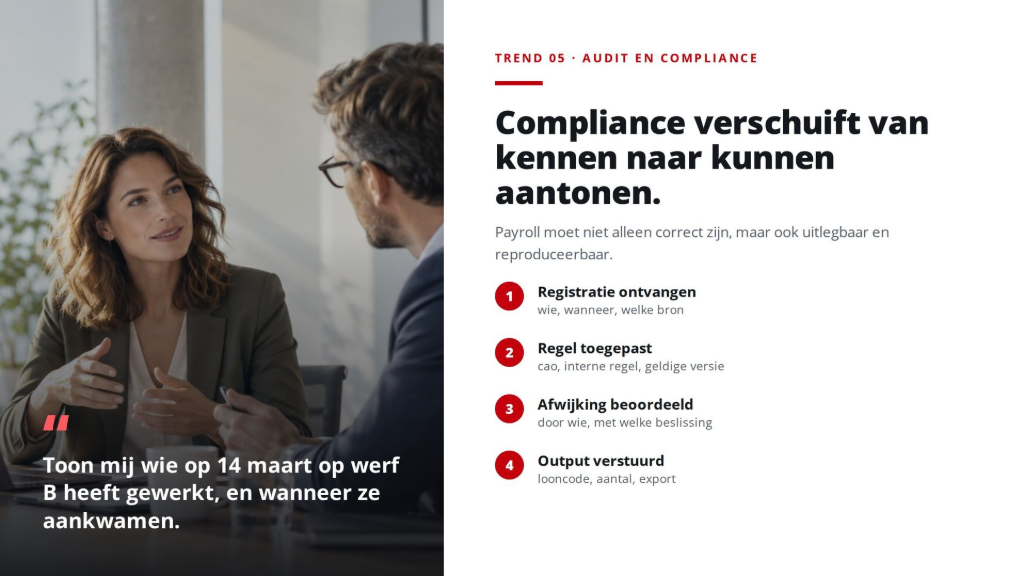
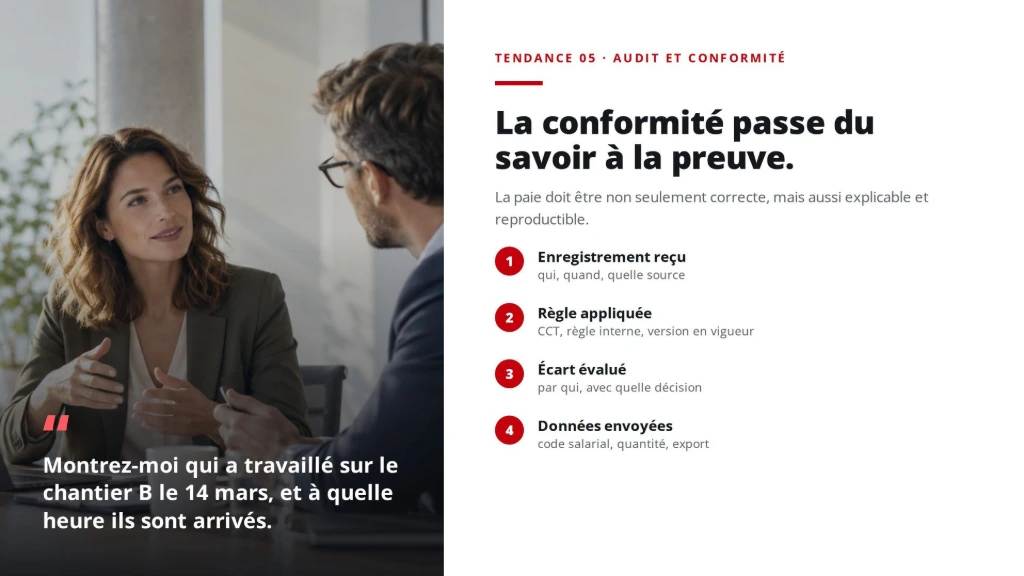
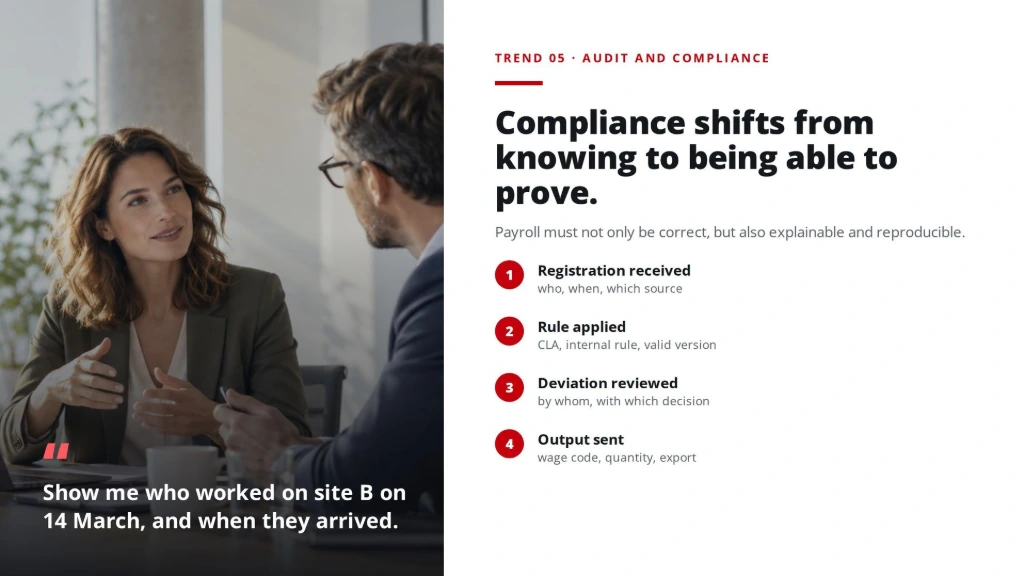
Suppose the question comes in: "Show me who worked at job site B on March 14, and when they arrived."
What is then delivered in many organizations: the planning for that week, the pay slips from March, a WhatsApp group, and the memory of the site manager. What is asked: who was actually there, the time of arrival and departure, who approved the deviations, and proof that it was not filled in afterwards.
Trend 5: audit en compliance
A complete audit trail follows each registration in four steps:
- Registration received: who, when, which source
- Rule applied: collective labor agreement, internal rule, version valid on that date
- Exception reviewed: by whom, with which decision
- Output sent: pay code, quantity, export
“The difference between planned and actually worked is not a detail. It is the whole file.”
Where companies are losing money today
Payroll errors rarely cost money due to one big mistake. They cost money due to the same small frictions every month that unnoticed eat away at the margin.
Friction | What happens? |
Manually collecting | HR asks what should actually have been available digitally. |
Excel dependency | Rules are in formulas, not in verifiable logic. |
Late deviations | Errors only come to light when payroll has to close. |
Discussions with employees | Overtime, mobility, and bonuses are reconstructed afterwards. |
No recalculation basis | Project cost follows too late or too inaccurately. |
Pre-payroll is daarom geen administratieve luxe, maar bescherming van marge en vertrouwen.
Self-test: is payroll knowledge in systems or in heads?
Think of your own organization, or a client you work for. Count how many of these eight questions can be answered with “yes” today, without anyone having to look anything up:
- Do we know how many voluntary overtime hours each employee has already taken?
- Does the team leader see that counter when he lets someone work longer?
- Is it recorded which hours fall under which overtime scheme?
- Can the system handle two night bonuses side by side, per date of employment?
- Do we see immediately with a sickness report if someone relapses within eight weeks?
- Can we show how the bonus services are distributed among our people?
- Can we show for a day last year who worked where, and who approved that?
- If a system assigns shifts: can someone explain why it chose that way?
Score | Where is the knowledge? | What happens? |
0 to 2 | In people | It works, as long as the same colleagues are there. If someone leaves, the knowledge leaves with them. |
3 to 5 | In files | Excel and agreements capture much, but no one knows for sure which version applies on which date. |
6 to 8 | In the system | A new rule is a setting, not a project. The work shifts to reviewing and adjusting. |
A low score says nothing about how well an organization performs. It does say something about how vulnerable it is when rules change or when someone leaves.
The missing link: between registration and payroll lies interpretation
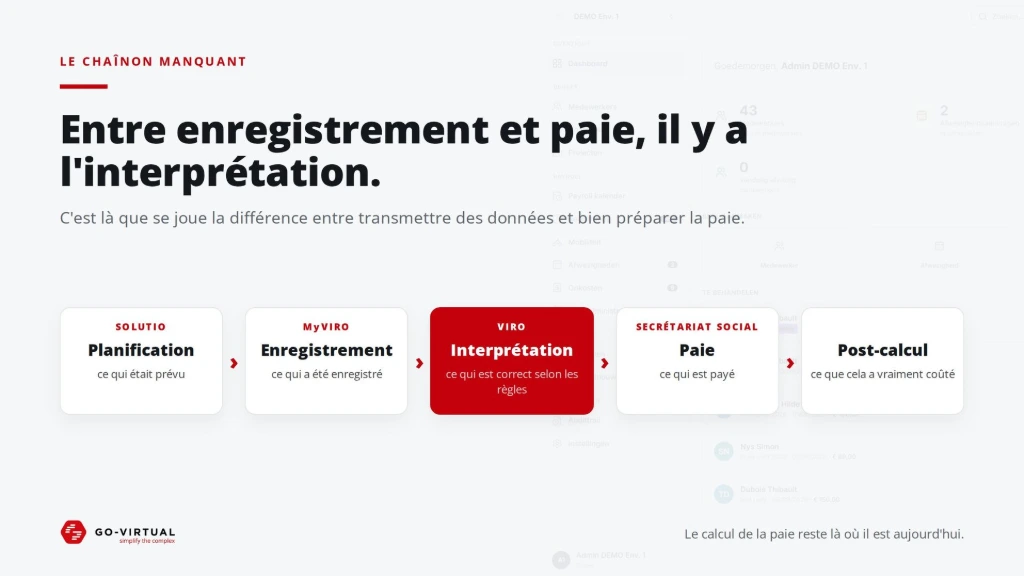
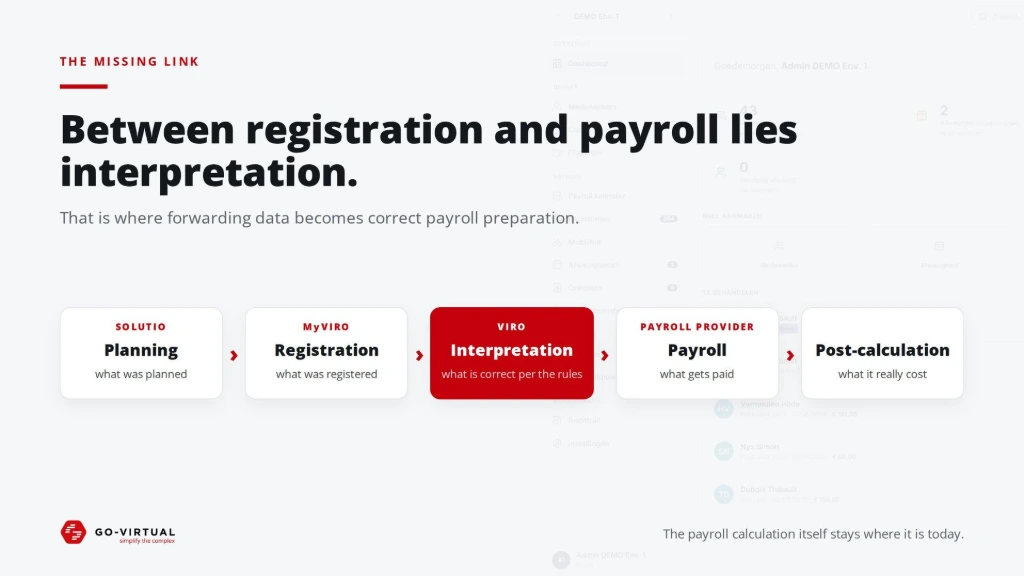
Put the five trends side by side and you see the same pattern every time. The problem rarely lies in the planning, and rarely in the pay calculation. It lies in the step in between: translating what happened operationally into what is correct according to the collective labor agreement, the contract and company rules.

Between registration and payroll lies interpretation
Step | Question |
Planning | What was planned? |
Registration | What was registered? |
Interpretation | What is correct according to the rules? |
Payroll | What is being paid out? |
Post-calculation | What did it really cost? |
That is exactly where the difference arises between passing data along and correct payroll preparation. At GO-VIRTUAL, we build that flow as one controlled whole: SOLUTIO for planning, MyVIRO as the employee self-service app for registration at the source, and VIRO as the pre-payroll layer that translates raw registrations into validated, payroll-ready output according to collective labor agreements and internal company rules. The pay calculation itself stays where it is today, with the payroll service provider or in the payroll software.
Conclusion: the payroll employee of tomorrow assesses, not reconstructs
The five trends all point in the same direction. Payroll is no longer a monthly process, but a continuous flow of registration, interpretation and validation. That fundamentally changes the work of the payroll professional: less reconstructing, less recalculating, more assessing and adjusting.
Organizations that extract knowledge from heads and loose files and anchor them as working rules in the process, win in three areas: fewer errors, less stress at the end of the month and a payroll they can explain at any time.
So the question is not whether payroll is changing. The question is where in your process quality is determined today.
Frequently asked questions
Continuous payroll means that registrations such as hours, absences, and mobility are checked and validated at the moment they occur, instead of only at the monthly payroll closing. The payroll calculation itself remains periodic, but the input is already validated.
Pre-payroll is the step between registration and payroll calculation. Raw registrations are translated into correct wage codes and amounts according to collective agreements, contracts, and internal company rules. Deviations are flagged before they enter the payroll.
No. AI primarily helps with processing messy input, such as registrations and reporting. The payroll calculation must remain exact and repeatable, and that requires fixed rules and human validation of deviations. The role of the payroll employee shifts to exception management.
In exception management, the payroll employee no longer checks every registration, but only what deviates from the applicable rules. Normal registrations flow through automatically, incomplete ones are fed back, and deviations appear on a control list.
Because organizations increasingly need to demonstrate why a salary is correct: which registration came in, which rule was applied, who approved a deviation, and what was sent to payroll. Without an audit trail, this must be reconstructed afterwards.
For organizations with shift work, mobile employees, multiple locations or sites, project work, complex collective labor agreement rules, or many exceptions. There, the distance between registration and correct payroll input is the greatest.
How far along is your organization?
Curious where in your payroll process quality is determined today? Contact GO-VIRTUAL for an exploratory conversation.
sales@go-virtual.com · +32 50 28 10 42
Sources: SD Worx, HR & Payroll Pulse 2026 (survey January to February 2026, 5,936 HR decision-makers and 16,500 employees in 16 European countries); Deloitte, 2026 Global Human Capital Trends; Deloitte Belgium, Payroll in Transition (2025).