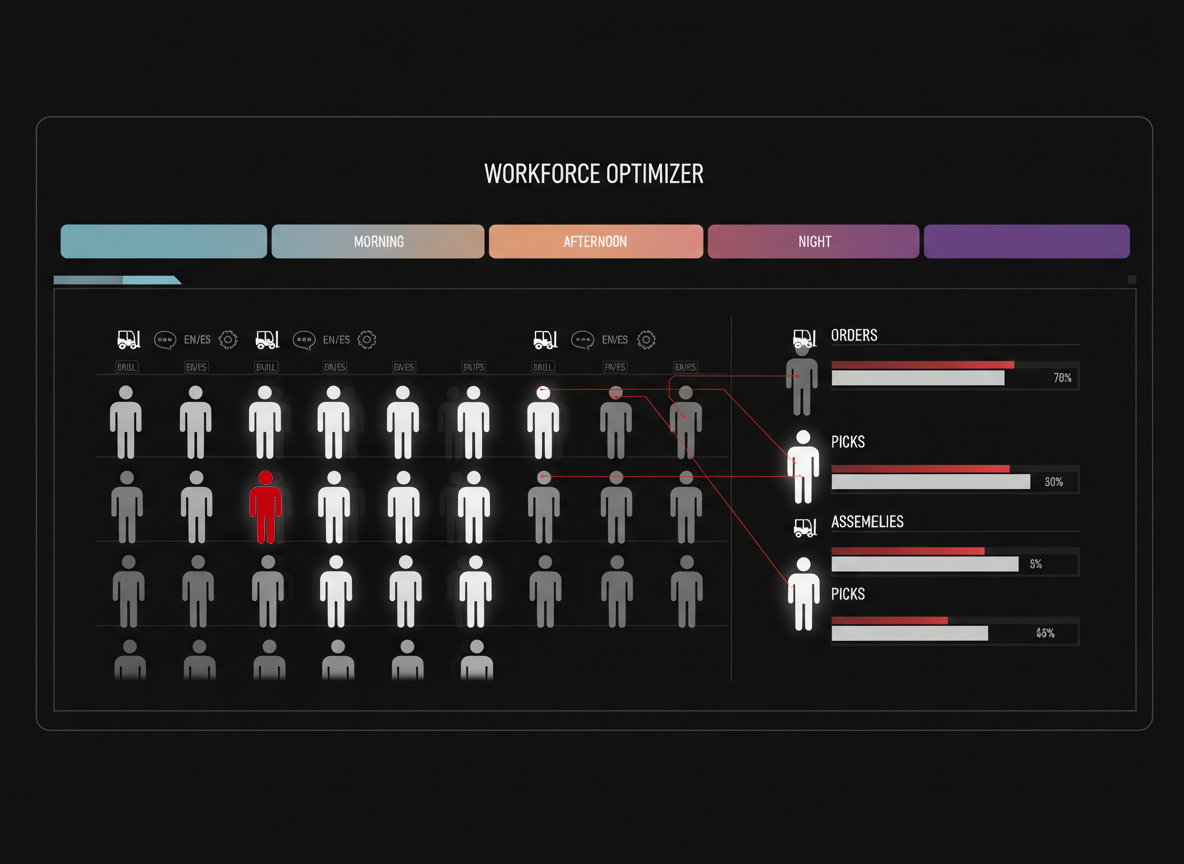
Exchanging shifts without scheduling chaos
Giving employees more freedom in scheduling only works if rules and visibility are in place.
Giving employees more freedom in scheduling only works when the rules are clear and everyone has the right visibility.
Why this matters more than ever
Planning pressure is increasing in almost every sector. Staffing margins are tighter, employees expect more flexibility, and planners are dealing with a growing number of changes. Trying to manage all of that manually eventually becomes unsustainable.
At the same time, this topic is moving even higher up the agenda in 2026. In workforce management, there is a clear shift toward giving frontline employees more flexibility, more say in their schedules, and access to models that allow organisations to redistribute shifts and capacity faster, while staying in control. UKG specifically highlights schedule flexibility, internal talent marketplaces, and more agile workforce models as key themes for 2026. (ukg.com)
That makes this relevant far beyond traditional shift-based environments. As soon as an organisation has to deal with staffing levels, skills, schedules, last-minute changes, and operational dependencies, the same question comes up: how do you give employees more room to move without losing control of the plan?
Why this matters more than ever
Planning pressure is increasing in almost every sector. Staffing margins are tighter, employees expect more flexibility, and planners are dealing with a growing number of changes. Trying to manage all of that manually eventually becomes unsustainable.
At the same time, this topic is moving even higher up the agenda in 2026. In workforce management, there is a clear shift toward giving frontline employees more flexibility, more say in their schedules, and access to models that allow organisations to redistribute shifts and capacity faster, while staying in control. UKG specifically highlights schedule flexibility, internal talent marketplaces, and more agile workforce models as key themes for 2026. (ukg.com)
That makes this relevant far beyond traditional shift-based environments. As soon as an organisation has to deal with staffing levels, skills, schedules, last-minute changes, and operational dependencies, the same question comes up: how do you give employees more room to move without losing control of the plan?
The mistake many organisations make
A common assumption is that the problem can be solved simply by letting employees choose or swap shifts themselves.
But that is not how it works.
Without clear rules, the chaos does not disappear. It just moves.
It shifts away from the planner and onto the shop floor.
It moves out of the planning system and into WhatsApp groups.
It no longer shows up in advance, but only once things have already gone wrong.
More freedom in scheduling only works when the system controls in advance what is allowed, what is not, and what requires approval.
What is minimally required
If you want to give employees more room to take over or swap shifts, the system has to do far more than simply display an open shift.
It also needs to verify whether the employee:
- has the right skills or certifications
- still meets the required rest periods
- is eligible to work at that location
- remains within their contract terms or working time rules
- does not create unwanted additional costs
- does not leave a gap somewhere else in the schedule
In addition, the planner or team lead must always retain visibility into what is changing, which requests are still pending, and where exceptions are being made.
That is where the real difference lies between flexibility and scheduling chaos.
A simple practical example
Suppose an employee sees an open shift and wants to take it.
Then the system must not only check if that person is available. It must also verify if that employee has the right profile, if the rest rules are still being respected, if the transfer is feasible, and if the cost remains within the agreed limits.
If everything is in order, that shift can be confirmed immediately.
If there is a risk, the system must warn or request approval.
This is not an unnecessary check. It is simply necessary to keep scheduling manageable.

Which rules make the difference
A mature approach is based on a few clear principles.
First and foremost, there are hard limits: certificates, safety conditions, legal rest periods, and minimum staffing must always be monitored.
Additionally, there are rules that make scheduling fairer and more stable. For example, you don't want the same people always taking the most interesting shifts. Or that a team is filled on paper but lacks crucial profiles in practice.
Timing also plays a role. Exchanging a shift three days in advance is different from doing so an hour before it starts. The closer to the event, the more important the control and approval.
How you can tell it works
When shifts can be exchanged or taken over properly, you notice it quickly.
- The fill rate is increasing.
- Planners spend less time on phone calls and ad-hoc changes.
- There are fewer last-minute gaps.
- There is less communication outside the system.
- And employees experience more flexibility without the organization losing control.
That's the point: giving employees more say in their planning does not make the process looser, but rather stronger, provided that the underlying logic is sound.
From flexibility to workable planning
Allowing shifts to be swapped or taken over may seem like a small extra flexibility at first glance. In reality, it touches the core of modern planning: how do you combine speed for employees with control for planners and team leads?
This only works if the underlying logic is correct. Not through loose agreements, not outside the system, but built into the planning process itself. Only then does flexibility become truly workable.
But it doesn't stop there. Once shifts change, hours, bonuses, allowances, mobility, or other compensations often shift as well. What seems like a small operational change can indeed have an impact in payroll preparation. That’s exactly why the step after planning must also be well organized.
From that reality, GO-VIRTUAL looks at the whole. On the planning side, you need to give employees more room without losing grip on staffing, competencies, and rules. On the prepayroll side, you need to ensure that such changes are also correctly translated into clear and manageable payroll preparation.
There is also the link with VIRO. Where planning needs to run smoothly, the processing afterwards must also be correct. Especially in situations where shifts are swapped, taken over, or adjusted, a strong prepayroll layer helps to avoid interpretation, manual corrections, and errors afterwards.
That is where the difference is made between flexibility that sounds good and flexibility that remains truly workable in practice.
The next step: is it also fairly distributed?
As soon as employees can more easily take or swap shifts, another question automatically arises:
Is this also fairly distributed?
Because flexibility alone is not enough. It must also remain workable, explainable, and fair for the team.
In the next blog, we will therefore look at fairness and wellbeing as real planning rules, not as separate HR principles.

Time for the next step?
Do you recognize these challenges in your organization? Then it is likely that your current approach to swapping and covering shifts has reached its limits.
With SOLUTIOGO-VIRTUAL helps companies tomake flexibility in planningworkable, with control over staffing, skills, rules, and visibility. WithVIROwe also ensure thatchanges in shifts are correctly translated into hours, allowances, and manageable payroll preparation.
Do you want to know what that can look like in practice? Then it might be time to view planning and prepayroll as a whole.